UK Heatwaves Worrying You? Shade The UK Has The Answer
Last week saw record temperatures soaring across Europe and the first (of likely several) UK heatwaves this year. Understandably, a lot of people feel afraid. As UK springs and summers get hotter, overheating of cities, buildings and public spaces is becoming a serious public health issue. In 2022, the UK saw record-breaking temperatures of 40.3°C, marking both a shift in public awareness and highlighting the urgent need for new policies to create more resilient, cooler cities.
It’s also become increasingly clear that extreme heat doesn’t impact everyone equally. As the climate emergency causes UK heatwaves to become more frequent, and temperatures continue to rise, more vulnerable people are dying from overheating. Those most at risk include: low-income households, young children, older adults, people with existing physical and mental health conditions, people experiencing homelessness and outdoor workers. To create safer and more equitable public spaces, we need strategies that prioritise the most vulnerable.
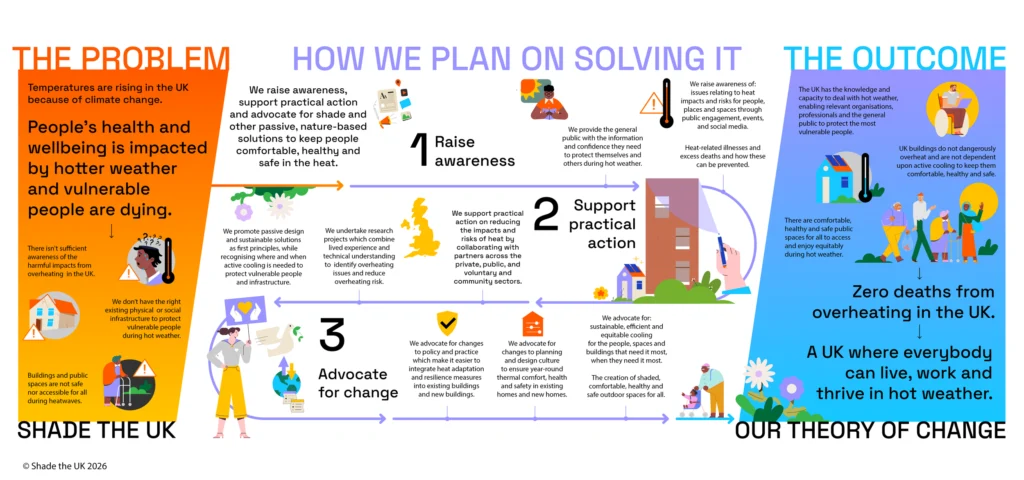
Enter Shade the UK, who work to raise awareness on overheating and its harmful impacts, improve existing physical infrastructure (buildings) to protect vulnerable people, and to make public green and shaded spaces safe and accessible for all. Their long-term goal is to ensure everyone in the UK has the knowledge and tools to deal with heatwaves and stay safe, UK buildings are no longer dangerously overheating, there is equitable access to safe green spaces, and there are NO deaths of vulnerable people in the UK from overheating.
The UK housing crisis is usually discussed in terms of availability and affordability. Yet there is another dimension that receives far less attention: the basic suitability of our homes for the climate we now inhabit.
Over the past couple of decades, housebuilding in the UK has largely ignored the increasing likelihood of severe heatwaves. When temperatures exceeded 40°C in 2022, the event exposed just how vulnerable many modern homes are to overheating. Apartments with large areas of glazing, limited shading and constrained ventilation can become extremely uncomfortable during hot weather. In some cases, indoor temperatures climb well above 30°C for extended periods, creating serious health risks for vulnerable groups including older people, young children and those with existing medical conditions. The uncomfortable truth is that we have built homes that trap heat rather than manage it…
The overheating of British homes is not the result of a single mistake. Rather, it reflects a series of design conventions that have gradually become normalised across the industry.
So let’s talk about what Shade the UK are doing to change things.
Who are Shade the UK?
Shade the UK is dedicated to adapting the built environment and public spaces to protect the vulnerable against a changing climate.
Their mission is simple: zero deaths from overheating in the UK, whilst protecting the health of vulnerable people. The ways to achieve this are more nuanced, but they can be done. They believe it’s possible to protect lives, enhance health, and build resilience, without repeating or amplifying the mistakes of the high-energy, high-inequality model of cooling (aka, putting air conditioning everywhere without any further adaptations or long-term sustainability in mind – more on this below).
Shade the UK believe that everyone has the right to live, work, and play in places that are safe, comfortable and sustainable, regardless of income, age, or health. They also believe that this is not just a matter of individual well-being, but of social justice and human rights. As climate breakdown and more UK heatwaves exacerbate existing inequalities and vulnerabilities, it is vital to ensure that those who are most at risk aren’t left behind.
At the core of this is the understanding that the climate crisis isn’t just an environmental issue, but a social and economic one that requires a holistic, inclusive, and compassionate response. By adapting the built environment and public spaces to protect the most vulnerable, we can create a society that is more resilient, more equitable, and more connected.
If you help the most vulnerable, you help everyone.
What is Shade the UK doing about UK heatwaves?
Shade the UK work with experienced sustainability consultants to support local communities, helping them adapt the built environment and green spaces in their unique areas to withstand increased temperatures.
They offer personalised retrofit advice to reduce the risk of overheating in properties. Using advanced thermal modelling tools and extensive expertise, they can assess a property and provide tailored adaptation and mitigation strategies. However, their commitment to creating cooler and safer communities extends beyond individual buildings. They also work closely with local authorities, care providers and housing associations, using surplus funds and donations to offset costs for working with vulnerable groups who need support most. For these groups, they provide tailored strategies for the specific challenges of heat stress and its impact on vulnerable community members.
What does protecting the vulnerable from UK heatwaves look like?
Over the past few years, Shade the UK have collaborated with a number of partners, such as major charities like the British Red Cross, educational institutions like the London School of Economics, and local authorities like Camden Council. In each project, they’ve worked to deliver climate adaptation strategies for the built environment, by combining their expertise with people’s lived experiences of extreme heat events. This work has already started to make a strong impact in London, increasing resilience and protecting vulnerable people in the city during UK heatwaves.
Some of my favourite examples include:
The Holborn Liveable Neighbourhood Heat Resilience Study
Focused on designing public spaces for extreme heat, Shade the UK and Love Design Studios’ Holborn Liveable Neighbourhood Heat Resilience Study is a research project commissioned by Camden Council. The study analyses the growing risks of hotter weather in Holborn’s public areas, and identifies a range of targeted adaptation measures that can help.
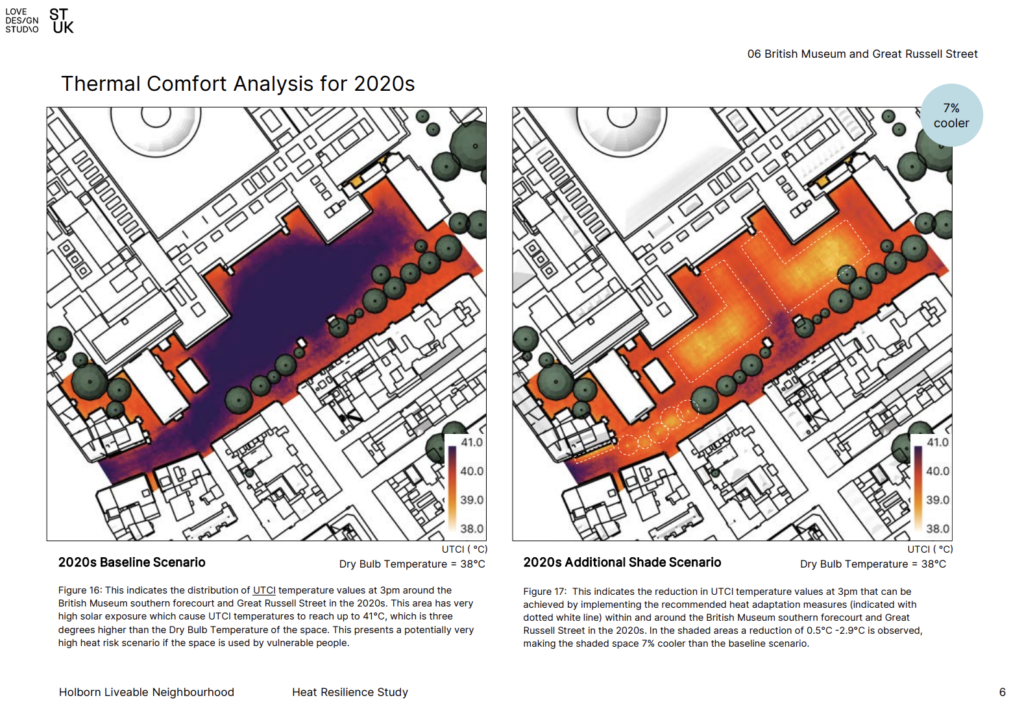
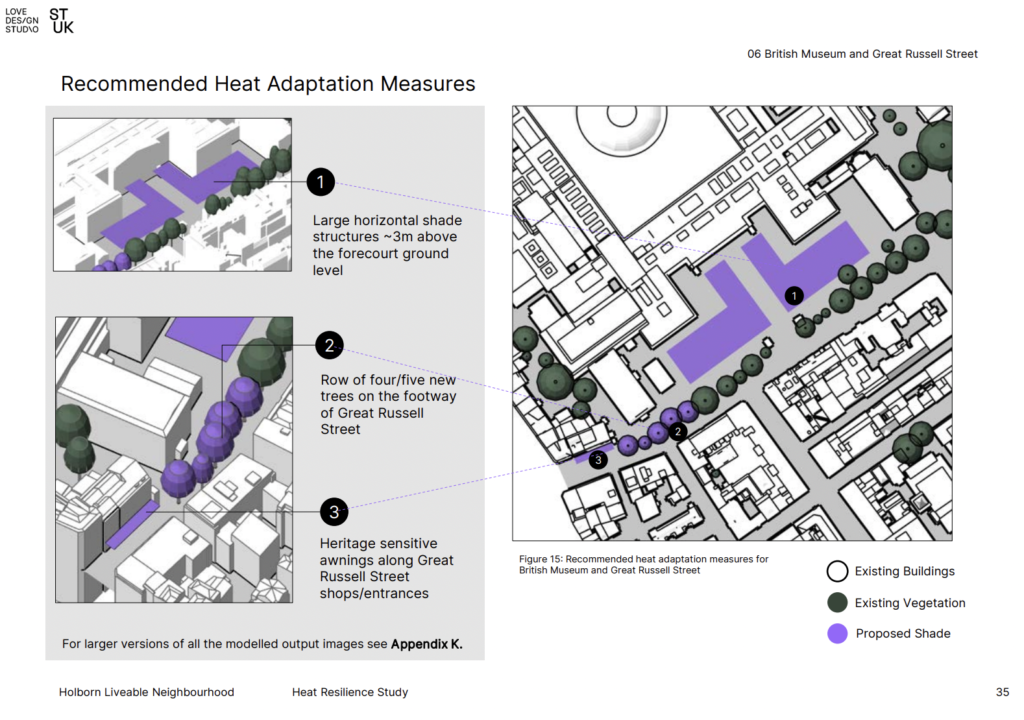
Holborn’s public spaces currently offer limited protection from extreme heat, with minimal shading and few spaces that provide relief from high temperatures. This means many streets and public areas are uncomfortable and potentially unsafe during UK heatwaves. Their study identifies targeted areas within Holborn that would benefit most from heat adaptation measures, including a detailed map of heat exposure, a list of the most exposed areas, and recommended adaptations for these hotspots.
Imagine if every neighbourhood in the UK invested in this knowledge and adaptation now?
The Overheating Adaptation Guides for Homes and Offices
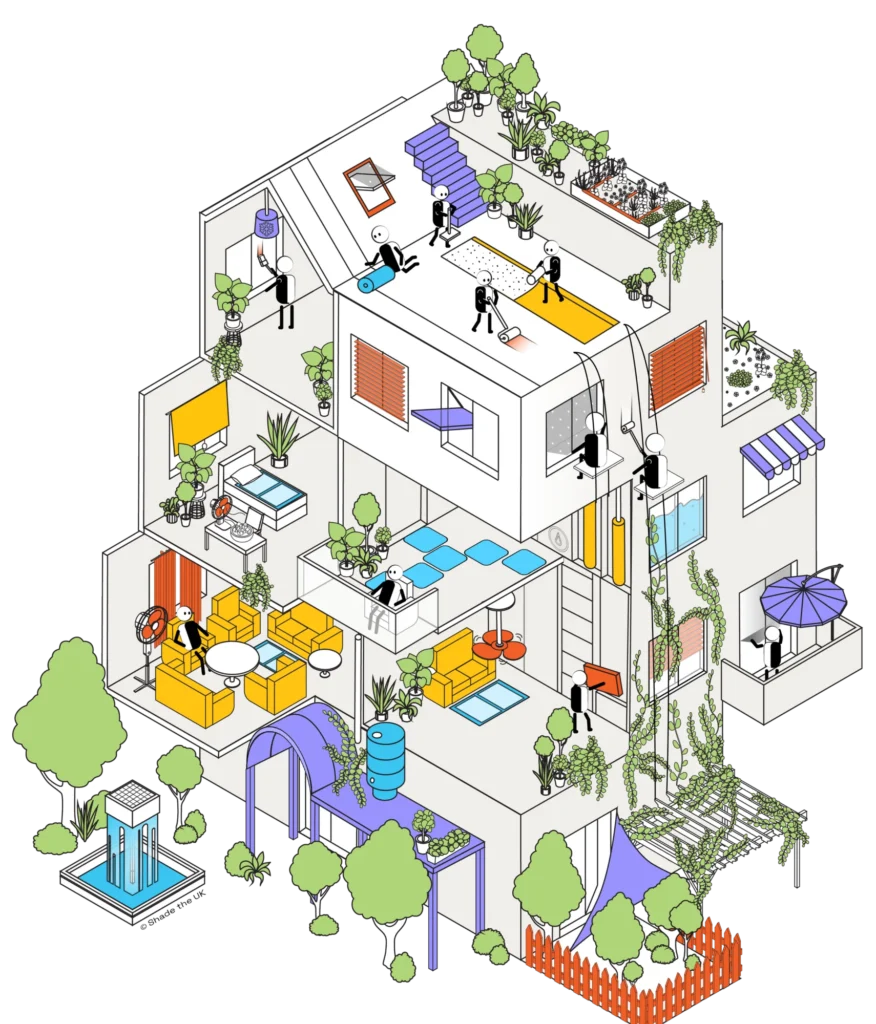
50% of people in the UK live in a home that overheats. Shade the UK’s Overheating Adaptation Guide for Homes, commissioned by the British Red Cross, provides 43 measures people can consider for their homes to mitigate against overheating, including external shade, internal shade, passive cooling, ventilation, and minimising internal heat gains. The guide aims to provide suitable measures for both homeowners and renters, flats and houses, and for all locations, building types, and budgets.
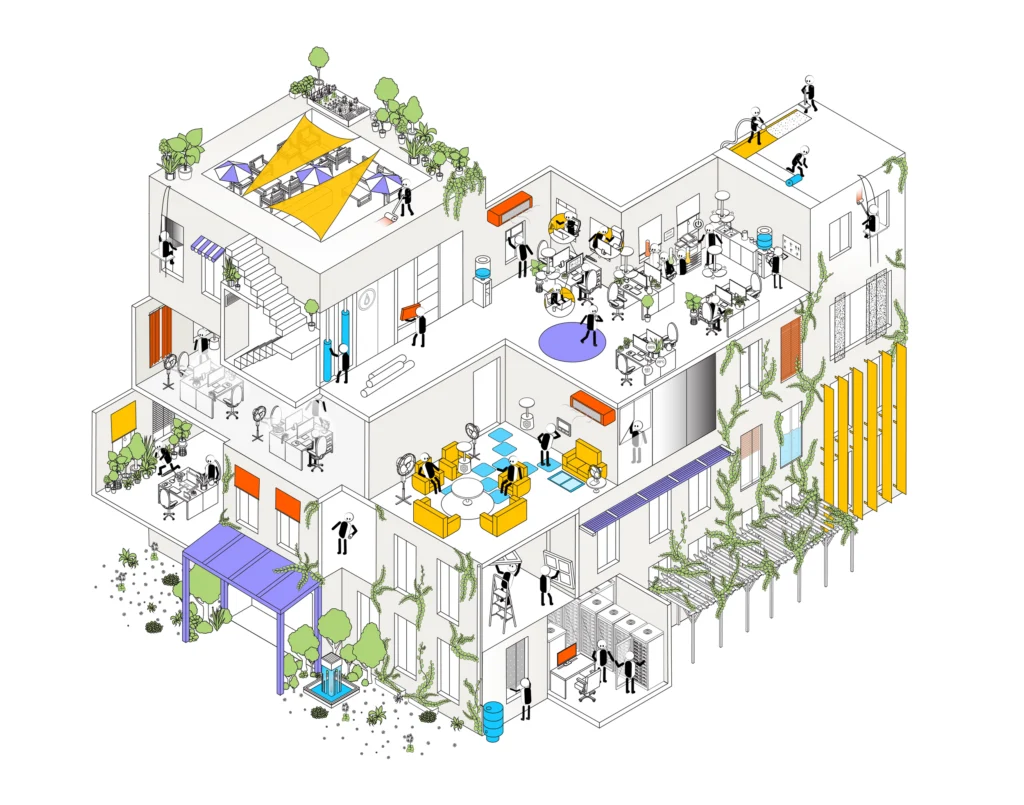
Shade the UK also developed The Overheating Adaptation Guide for Offices, a tool for both office landlords and tenants to understand the various overheating measures available to improve comfort, reduce reliance on air conditioning, and improve the health and wellbeing of occupants.
It includes solutions for a wide range of office building types, including listed and non-listed buildings, as well as different fit-out stages and budgets.
Advice for Extreme Heat and UK Heatwaves
Shade the UK also created a guide for taking care during heatwaves. Some of my favourite pieces of advice (that I didn’t know about before!) is using sites like the London Tree Canopy Map to plan a route ahead of time using covered/shaded paths, as well as finding places to shelter through London Cool Spaces, which provides a map of buildings with amenities to help you cope in hot weather such as community centres, public libraries, museums, cinemas and sports centres. Again, imagine if every town and city had these resources readily available?
Plus, you can also register to receive heat-health alerts notifications when a heatwave is expected.
Building Heat-Resilient Neighbourhoods
In collaboration with Grantham Research Institute at the London School of Economics, and Love Design Studio, this project aimed to introduce understandable and useful overheating metrics within Islington, which has been identified as one of the most vulnerable boroughs in London when it comes to climate breakdown. The existing tools used to communicate overheating risks within buildings are highly complex; relying on complicated formulas that make it difficult to convey the problem to normal people. This makes it hard to spread awareness, or to help people understand what could reduce risks.
The project collected stories from Islington residents to capture their experiences of living and working in overheated buildings. Their experiences provided human stories that explained how buildings performed in higher temperatures, and who was at risk. From young children to hospital staff to people with long-term health conditions, the people of Islington were not protected for the impacts of increasing temperatures. The report combined this with technical assessments of Islington to demonstrate the extent of the issue across the borough, with all different building types showing concerning internal temperatures, highlighting the need for proper action.
A roundtable event was held to collect feedback on what a successful overheating index could look like. Participants included architects, local authorities, tenant’s associations, and local businesses.
All this research leads us to…
A real answer to the air conditioning question
When it comes to the air conditioning argument, Shade the UK also have a nuanced, balanced take on this too. Check out their full take on air conditioning culture wars here, but ultimately:
One of the biggest challenges we face is that, unlike energy performance, overheating risk in UK buildings is poorly recorded, poorly understood, and rarely monitored in any systematic way. With energy, tools like EPCs and billing data already tell us which buildings are inefficient and where investment is needed. With heat, there is no equivalent national picture. We simply do not measure internal temperatures at scale, and we rarely track where people are most at risk.
This lack of evidence leaves us in danger of applying the wrong solutions to the wrong buildings. Without good data, there is a real risk that we respond to fear and headlines rather than need; installing large, expensive, energy-hungry cooling systems where simple, affordable interventions such as external shutters, better ventilation strategies, solar control glazing, tree planting, or smarter window-opening regimes would have kept spaces safe and comfortable.
Shade the UK believes that before we default to an ‘air conditioning nation’, we need to understand which homes, schools, workplaces and community spaces are genuinely at risk, and what least-energy, lowest-cost solutions can protect people first. That is why we are advocating for large-scale understanding of heat resilience across the UK’s building stock, supported by monitoring, better data, improved planning and conservation laws, and practical, human-centred guidance.
The ultimate goal is to invest in better data, monitoring, and assessment so people, building owners, and local authorities can understand which buildings and communities are genuinely at risk from overheating, and what proportionate measures are needed.
This looks like:
- Developing an EPC-style heat resilience rating for homes and buildings at the point of sale or lease, as well as targeted monitoring in key buildings such as schools, care homes, hospitals and social housing.
- Creating borough-level heat risk maps, as they’ve done for Holborn, and pairing these with community workshops to understand local issues and lived experience, like they’ve carried out in Islington.
- Launching a national heat risk awareness campaign, helping people understand vulnerability and take practical action.
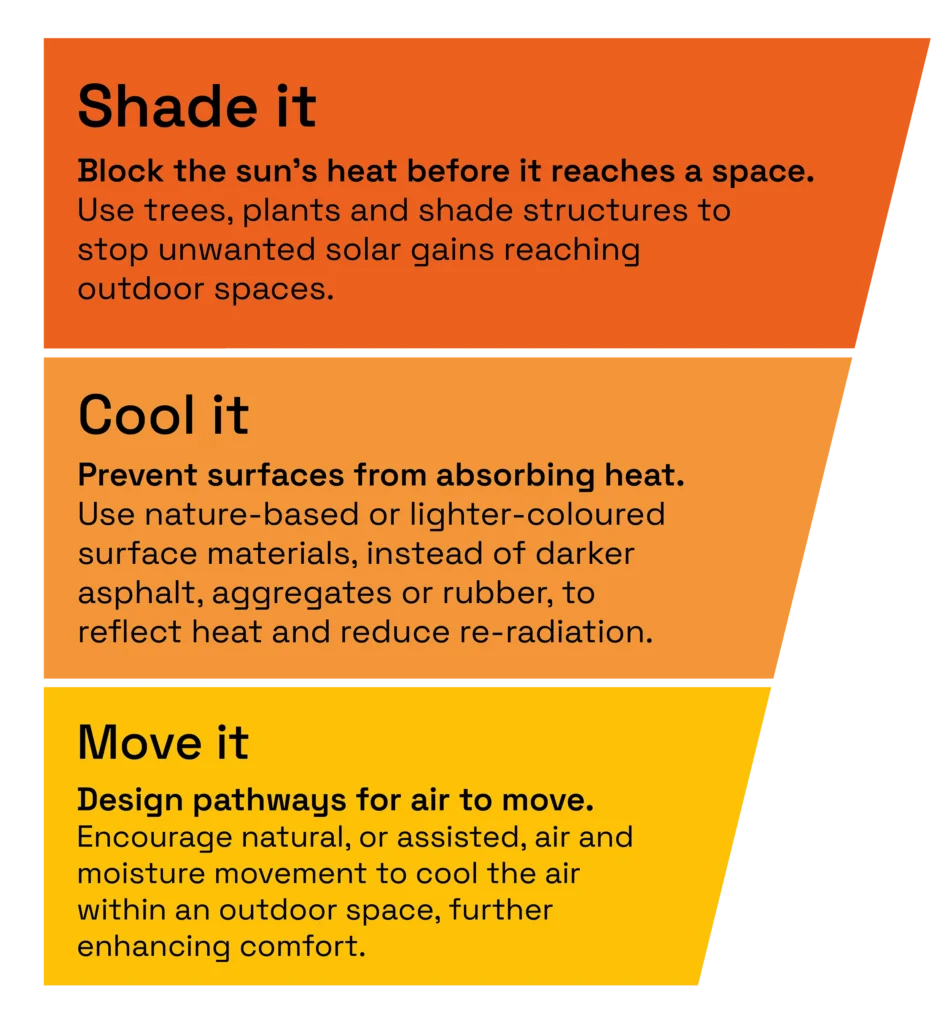
- Prioritising passive and preventative cooling wherever possible, through design, greening, and behavioural adaptation.
- Using active cooling (air conditioning) responsibly and equitably, targeted to protect health and save lives when passive measures aren’t enough or are unable to be installed
- Reform systems and policies to make low-energy, climate-adaptive design the easier, not harder, choice.
Shade the UK will continue to work with partners across the public health, housing, planning and design sectors to ensure that the UK stays cool, effectively, affordably, and equitably.
The question is: do we want a future where comfort and safety in extreme heat depends on income and power supply, or do we want to create one where everyone has the right to a cool, healthy home and neighbourhood?