Inside The Human Rights & Environmental Impact Of The 2026 World Cup

The 2026 World Cup has recently gotten underway, with games taking place across the United States of America, Canada and Mexico. Held every four years, the World Cup is gargantuan. In fact, it’s the most-watched and celebrated tournament on Earth. Approximately 1.42 billion people watched the 2022 final, while an estimated 5.9 billion people – nearly three-quarters of the world’s population – engaged with the tournament, digitally or physically. But research is also clear: the environmental impact of the 2026 World Cup is on track to be one of the most damaging on record, alongside multiple human rights abuses.
FIFA routinely markets its tournaments as carbon neutral. However, advertising regulators have previously ruled these claims to be false and examples of greenwashing, determining that the massive logistical emissions of mega sporting events make genuine neutrality mathematically impossible. In a landmark 2023 ruling in response to a complaint from climate groups, the Swiss Commission for Fairness determined that FIFA made legally false and misleading statements regarding the carbon neutrality of the Qatar tournament.
Let’s look at the key issues for the 2026 tournament.
The worst environmental impact of any World Cup
New Weather Institute’s report FIFA’s Climate Blind Spot – the Men’s World Cup in a Warming World reveals that this year’s World Cup is on track to become the most climate-damaging in the tournament’s 95-year history. The research finds that the 2026 World Cup will generate over 9 million tonnes of carbon dioxide equivalent. This is the same as nearly 6.5 million average British cars being driven for an entire year, and is almost double the historical average attributable to World Cup Finals tournaments from 2010-2022.
What’s even wilder is that FIFA launched a climate strategy at COP26 in 2021, pledging to cut its organisational emissions by 50% by 2030, and reach net zero by 2040, through 18 targeted actions. On closer analysis, only 2 actions have been completed, 2 have made only limited progress, and 14 have seen no visible progress – an 11% delivery rate in three years. On top of this, its targets don’t cover the tournaments that it coordinates, completely excluding the major pollution from events like the World Cup. This failure isn’t due to a lack of resources, as FIFA has $11 billion budgeted for 2023–2026. It represents a lack of accountability and an inability to take the climate crisis seriously.
Despite promising regular updates, FIFA has also not published any bi-annual climate reports, nor the 2022 World Cup sustainability follow-ups or the 2026 World Cup sustainability strategy. This severe lack of transparency falls far short of UN climate commitments, such as the Sport For Climate Action Framework. Frankly, it’s embarrassing.
The environmental impact of air travel for the World Cup
The 2026 World Cup pollution figures are significantly driven by a massive reliance on flights, alongside a major increase in the number of matches – up from 64 to 104 – due to FIFA expanding the tournament from 32 teams to 48.
With fixtures spread across four time zones and the 16 stadiums up to 2,800 miles apart, this year’s tournament is heavily dependent on air travel for teams, officials, media, and millions of fans. Unlike in parts of Europe or Asia, there are no low-carbon alternatives such as high-speed rail. Therefore flying, the most emissions-intensive form of travel, will be the default transport choice.
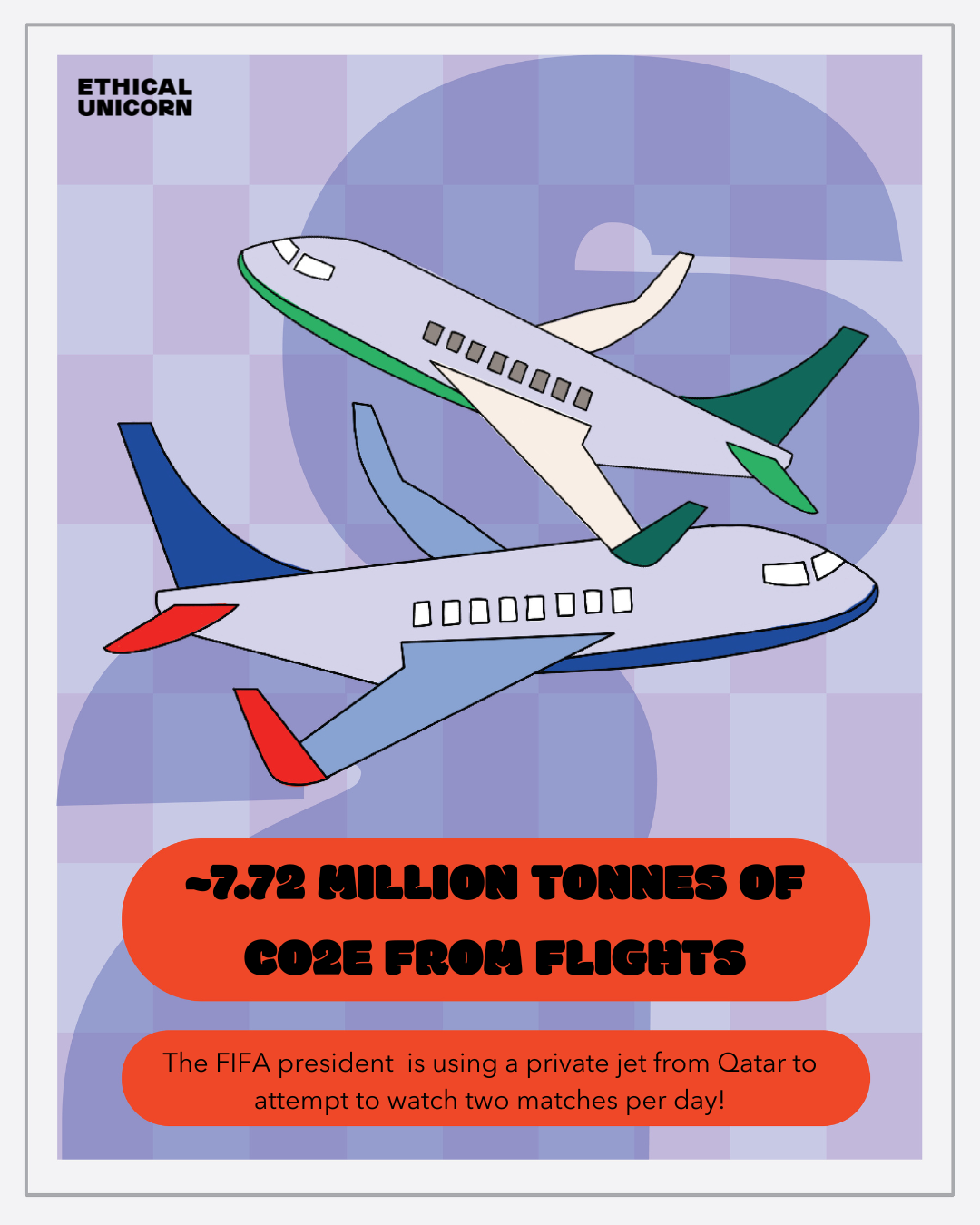
While total emissions are estimated at 9.02 million tCO2e, air transport will make up ~7.72 million tCO2e of the total. This is made even worse by the confirmation that FIFA president Gianni Infantino is using a private jet from Qatar to attempt to watch two matches per day.
Powered by Saudi Arabian oil
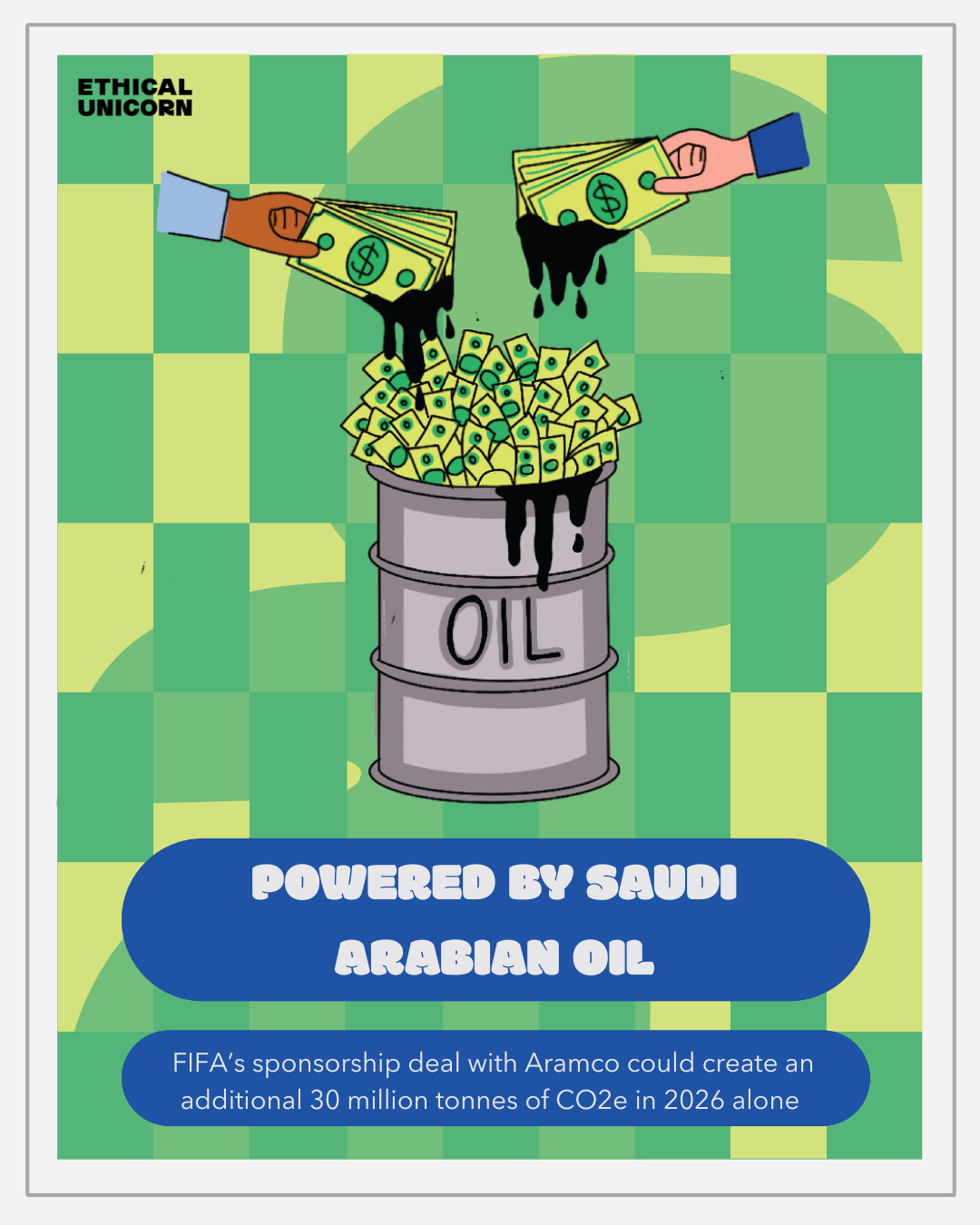
Adding insult to injury, the environmental impact of the World Cup skyrockets when we take into account how FIFA actively cosies up to some of the largest global polluters. In April 2024, FIFA confirmed Aramco as a Major Worldwide Partner – aka its biggest sponsor – in a deal running until the end of 2027 that covers both the 2026 men’s World Cup and the 2027 Women’s World Cup. The Saudi Arabian state-owned oil company is the largest oil company on the planet, in both historical and current emissions. FIFA’s sponsorship deal with Aramco could therefore create an additional 30 million tonnes of CO2e in 2026 alone, due to promotion of the oil giant at the World Cup.
A new report argues that this is no ordinary sponsorship. Football Ignites the World, published by FairSquare alongside Fossil Free Football, Reclame Fossielvrij and Badvertising, makes the case that FIFA’s deal with Aramco is arguably the most dangerous example of fossil fuel advertising and sponsorship the world has ever seen – and that it should renew the push for a ban on fossil fuel advertising across Europe and beyond.
The report is built on detailed research, established climate science and expert legal analysis; setting out the unique danger Saudi Arabia and Aramco pose to the climate. It examines Aramco’s vast reserves and business model, Saudi Arabia’s record of obstructing climate negotiations, and the petrostate’s work to keep global oil demand high. It explains how fossil fuel advertising works on us, and how the reach and emotional pull of sport supercharge this effect. Not only is this sponsorship deal disastrous for the planet, it helps an authoritarian state, with a string of egregious human rights abuses, continue to gain power and favour on the global stage through sport.
Climate impacts on host cities
The thing is, these climate impacts aren’t far in the future. Athletes and fans are feeling them now, and the environmental impact of this World Cup will only make things worse. Following fears from leading global experts on the health and safety of players, officials and fans in hot conditions, the Cool Down Network recently launched climate guides for six of the host cities (Atlanta, Dallas, Houston, Kansas, Miami and Monterrey) most likely to experience extreme heat. According to the experts, FIFA is unprepared for extreme temperatures, with inadequate guidelines that are out of step with the latest climate science and understanding of athletes under heat stress.
Plus, leading medical experts recently wrote to FIFA saying that its WBGT guidelines are outdated and urgently need revision to fulfil its duty of care to players. Other professional sports bodies propose cooling breaks at a significantly lower WBGT threshold of 26°C, and propose delay or postponement of fixtures at WBGT of 28°C. Meanwhile, FIFA’s temperature threshold remains at a whopping 32°C. During a 2024 Copa America match in Kansas City, a Guatemalan assistant referee collapsed on the pitch from extreme heat. The ambient air was 33°C with over 50% humidity, yielding a WBGT of roughly 27.5°C.
Some other key climate facts from the guides include:
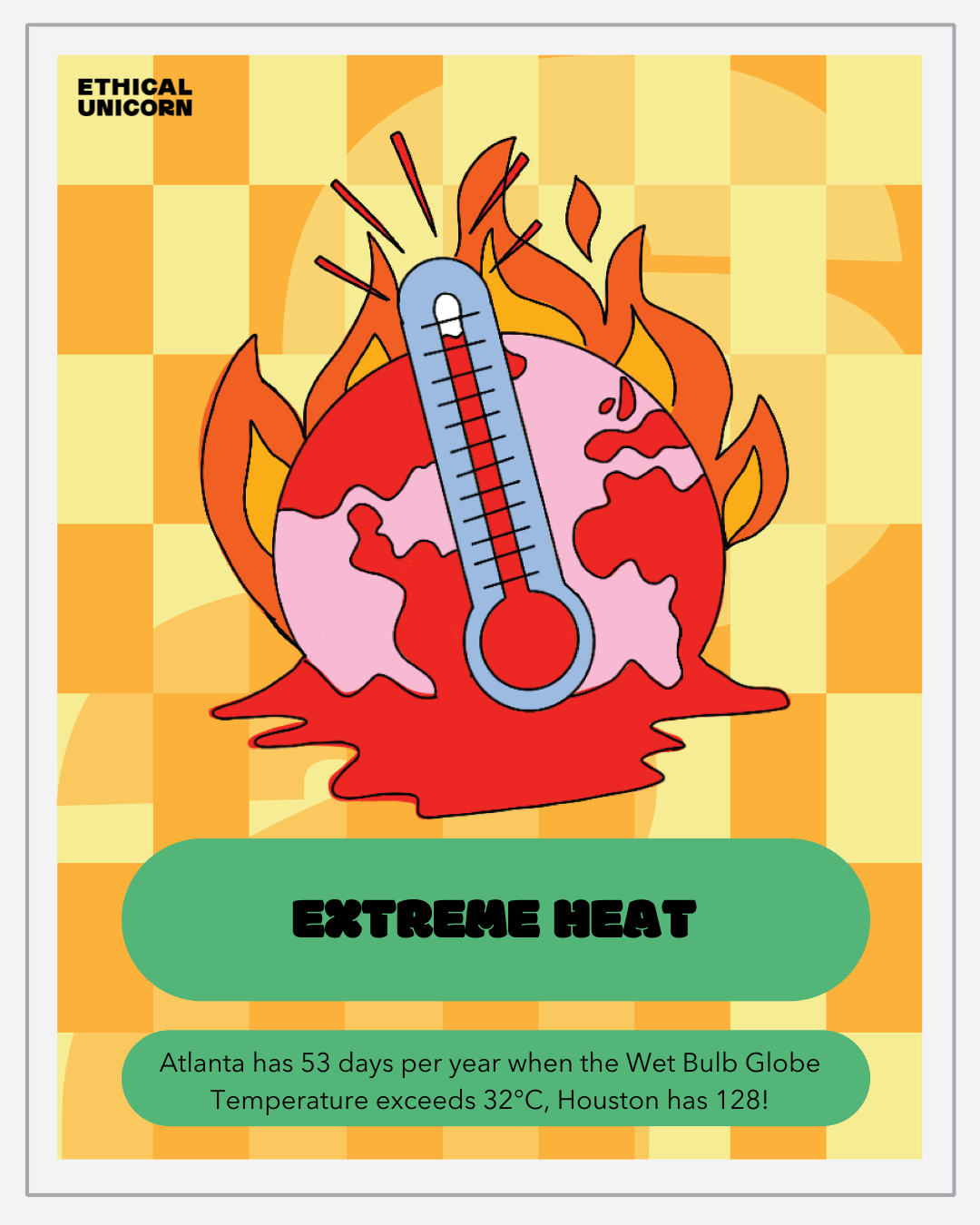
- Atlanta has an average of 53 days per year when the Wet Bulb Globe Temperature exceeds 32°C, while Houston has 128 days per year.
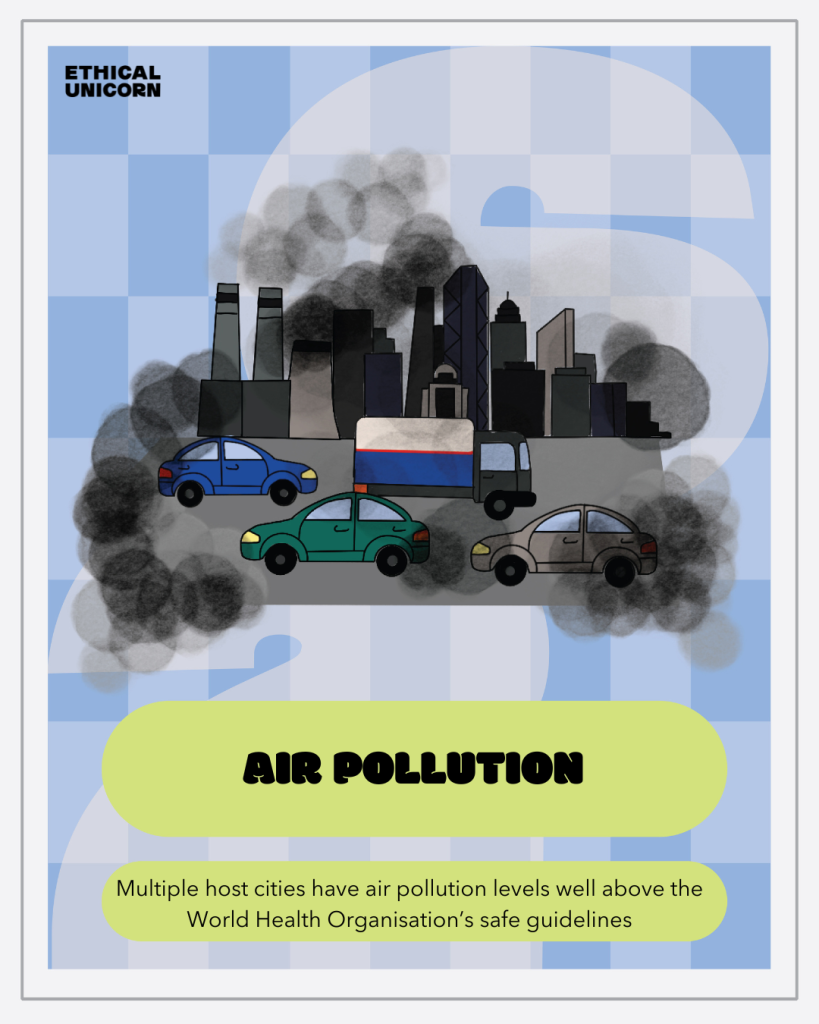
- Atlanta, Dallas, and Houston all report average levels of particulate air pollution that are well above the World Health Organisation’s safe guideline, while local climate risk assessments indicate that Kansas City’s air quality is “barely within healthy limits” and Monterey’s average levels of particulate pollution are almost three times above the WHO safety levels.
Extreme weather & the environmental impact of the World Cup
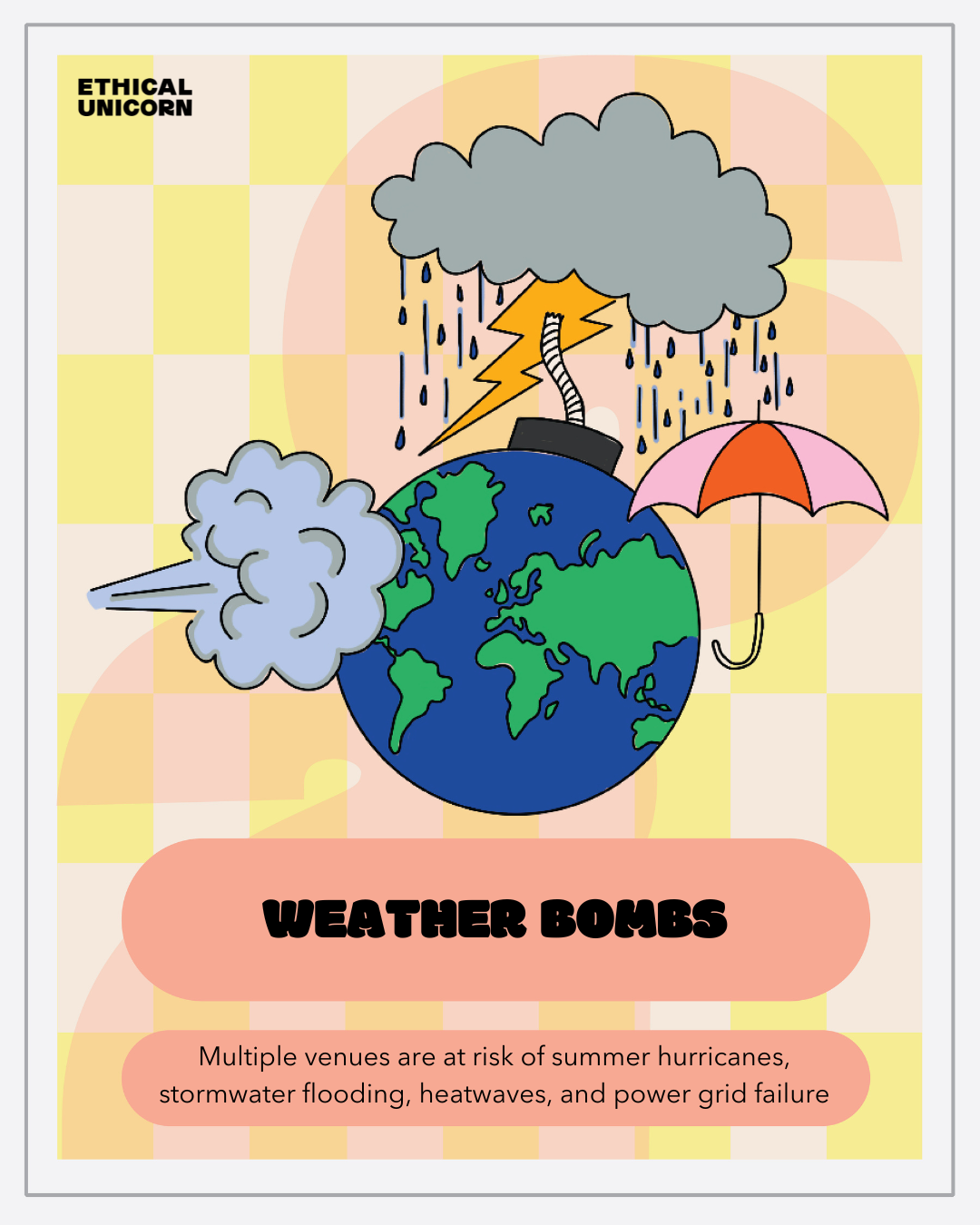
When it comes to more extreme weather and environmental conditions, all of which are worsened by climate breakdown, the host cities are also particularly vulnerable. Some concerns include:
- The Texas power grid faces severe reliability risks. The massive surge in energy demand required to keep the stadium cool, alongside a sudden influx of hundreds of thousands of visitors, threatens to push the notoriously fragile grid to the brink of failure during peak summer heatwaves.
- Atlanta Westside neighborhoods have historically been plagued by severe stormwater flooding.
- In July 2024 Hurricane Beryl tore sections off the Houston Stadium roof, killed 11 people and produced surges of up to 8 feet. The 2026 tournament schedule coincides with the early peak of the Atlantic hurricane season, meaning venues like Houston are threatened by rapid storm intensification and flooding.
- In March 2026 Texas Governor Greg Abbott was forced to stage swift water rescue boats and other resources across the state as heavy rain and lightning left 83,500 Houston customers without power.
- Miami’s stadium scores 8.1 out of 10 property risk score for flooding, while sitting in a vulnerable hurricane zone. If a major storm hits the area, heavy rainfall could easily overwhelm local roads and drainage systems.
- Miami is also projected to experience 100-year-storm rainfall events, dumping up to 571 millimeters of rain per day. Modelled flood depths suggest water could reach up to 2.2 meters in the areas surrounding the stadium, threatening emergency evacuation routes and fan safety.
- In Monterey, the region can swing between severe droughts and catastrophic floods. In early 2026, the federal government declared a renewed drought alert for 13 local municipalities, while the area is also highly vulnerable to summer hurricanes.

Labour and human rights
But it’s not just the environmental impact of the World Cup that matters, people are at risk too. In December 2025, FIFA baffled many by awarding its first Peace Prize to Donald Trump. Human Rights Watch and the ACLU strongly condemned the move, pointing out the stark hypocrisy of awarding a peace prize against a backdrop of ICE violence. Human Rights Watch and the Sport and Rights Alliance are pressuring FIFA to ensure that host city security plans include agreements against racial profiling, arbitrary detention and unlawful immigration enforcement during the tournament. Others warn that FIFA risks becoming a PR tool for an increasingly authoritarian US government amid a backdrop of violent immigration raids. The ACLU has also publicly demanded that attending a soccer match must never result in deportation, especially as the Trump administration escalates the deployment of the National Guard to host cities.
Other key concerns include:
- Atlanta faces severe heat risks for workers such as security staff, sanitation workers, and hospitality crews. For workers who aren’t used to the heat, such as temporary hires or volunteers, performing continuous moderate work in Atlanta’s daily high temperatures leads to an astonishing six to ten hours of daily exposure that exceeds safe limits set by the National Institute for Occupational Safety and Health. Plus, workers required to wear heavy security gear or mascot costumes face severely intensified heat stress.
- In Texas, the 2023 Death Star Bill overturned local city ordinances in Dallas and Austin that previously mandated shaded rest and water breaks for outdoor workers. This legislation blocks municipalities from passing life-saving heat protections.
- 22.3% of Houston construction workers have experienced labour trafficking, with workers reporting coercive recruitment, withheld pay, and a lack of protective gear.
- Houston’s Harris County is a national hotspot for deportation, with an estimated 6,612 residents physically deported by ICE in a single year.
- Miami promotes itself as a welcoming “gateway to the world” for the tournament, but Florida has been the epicentre of a massive surge in immigration enforcement fueled by Senate Bill 1718, and broad agreements between local police and federal agencies. Human Rights Watch has documented that detainees at local facilities face severe overcrowding, medical neglect and degrading treatment. Florida’s aggressive anti-immigrant laws have created a climate of fear, which has caused 66% of non-citizen immigrants in Florida to hesitate before seeking medical care, leading to untreated chronic conditions and increased public health risks across the region.
- The political climate is also actively disrupting football festivities. A recent Club World Cup event hosted by Telemundo in the Miami area was cancelled following an unexpected Coast Guard inspection that involved a Border Patrol agent. Local labour leaders have publicly warned that there is “no guarantee” that ICE agents will not be stationed at the 2026 World Cup.
- Florida state law also pre-empts local municipal governments from setting their own minimum wages or mandating heat and workplace safety standards. Because of these state-level restrictions, city officials cannot legally force tournament organisers or private developers to guarantee a $15 minimum wage or provide mandatory water and shade breaks during brutal summer months. This has severe consequences: recent surveys by local advocacy groups like WeCount reveal that hundreds of Miami construction workers already suffer from rampant wage theft and cannot afford basic groceries or health insurance.
- As of April 2026 Monterey is battling a deadly combination of toxic industrial smog, extreme heat and severe droughts. While local officials laud flashy stadium upgrades and implement strict new security perimeters, local residents are choking as factories pump dangerous levels of lead arsenic and cadmium into densely populated neighbourhoods, all to recycle hazardous waste from the US. This causes an estimated 2,500 deaths per year in the Monterrey region, as well as contributing to chronic ailments and cancer.

The beautiful game, corrupted
When operating at its best, the power of sport can be a beautiful thing. Fan communities are some of the most powerful on the planet, from fans supporting foodbanks to Bosnians marching to chants of Free Palestine in Toronto. That’s why it’s not ok for FIFA to take the beautiful elements of loving sport, and twist it into something so harmful. Fans, athletes and the planet deserve better.
If you’re a fan and want to see change, check out the work the Cool Down Climate Network, Badvertising and FairSquare are doing.